ARE YOU RIDING A LAME HORSE? OBJECTIVE LAMENESS DIAGNOSIS CAN HELP FIGURE IT OUT.
first wrote this post 5 years ago. It needed updating…
It is sad how many horses have to do their jobs lame– in enough pain in a limb to show gait deficits. It is shameful really- when you think about it- that in this day and age the industry isn’t more aware and doesn’t do a better job protecting horses. People who profess to love horses: riders, trainers, owners, judges- professionals who notice so many things about horses- sadly often fail to notice mild lameness. They shrug it off as poor ability, poor performance, or bad luck. Since horse people, even professionals, are not usually trained to detect lameness, it gets missed. If those folks don’t then work with an experienced equine vet who WILL notice it, and will help them manage it, then their horses suffer. Whatever type of horse it is, whatever discipline its used for, whatever its level of work, a ridden horse should be as comfortable as it can be.
Even pain that is subtle enough not to be detectable by riders, owners or trainers. can cause poor performance and can lead to all kinds of other problems. Besides the impact to performance in any discipline, lameness and pain in ridden horses may just be the greatest equine welfare issue there is! An important function for an equine vet is to detect even subtle lameness, help reduce, eliminate or manage it such that a horse is acceptably comfortable, and to slow or prevent worsening of the condition over time, given the horse’s work type and load.
Lets face it…. doing many of the things we ask horses to do under saddle is not easy, and it is not always comfortable for them. Like every human athlete, even sound ridden horses will have discomfort here and there. Whether it is because of saddle fit, rider factors, other health issues, or actual lameness, many horses perform at high levels through some pain. Think about it though… a human athlete can communicate that they are in pain, and where it hurts. Horses can and do communicate that they hurt, but it is subtle, and it is not communicated in a language that most people understand. Even well-meaning equestrians often miss the signs and just keep asking their horses to work, wondering why they aren’t doing as well as they would like. As lameness clinicians, our job is to decipher this. First, we must determine whether there is lameness, then determine what limbs and what structures are painful, what the nature of the problems in those structures are ,whether those problems can be helped, and finally the options available for helping. In order to know those things, we have to make a diagnosis.
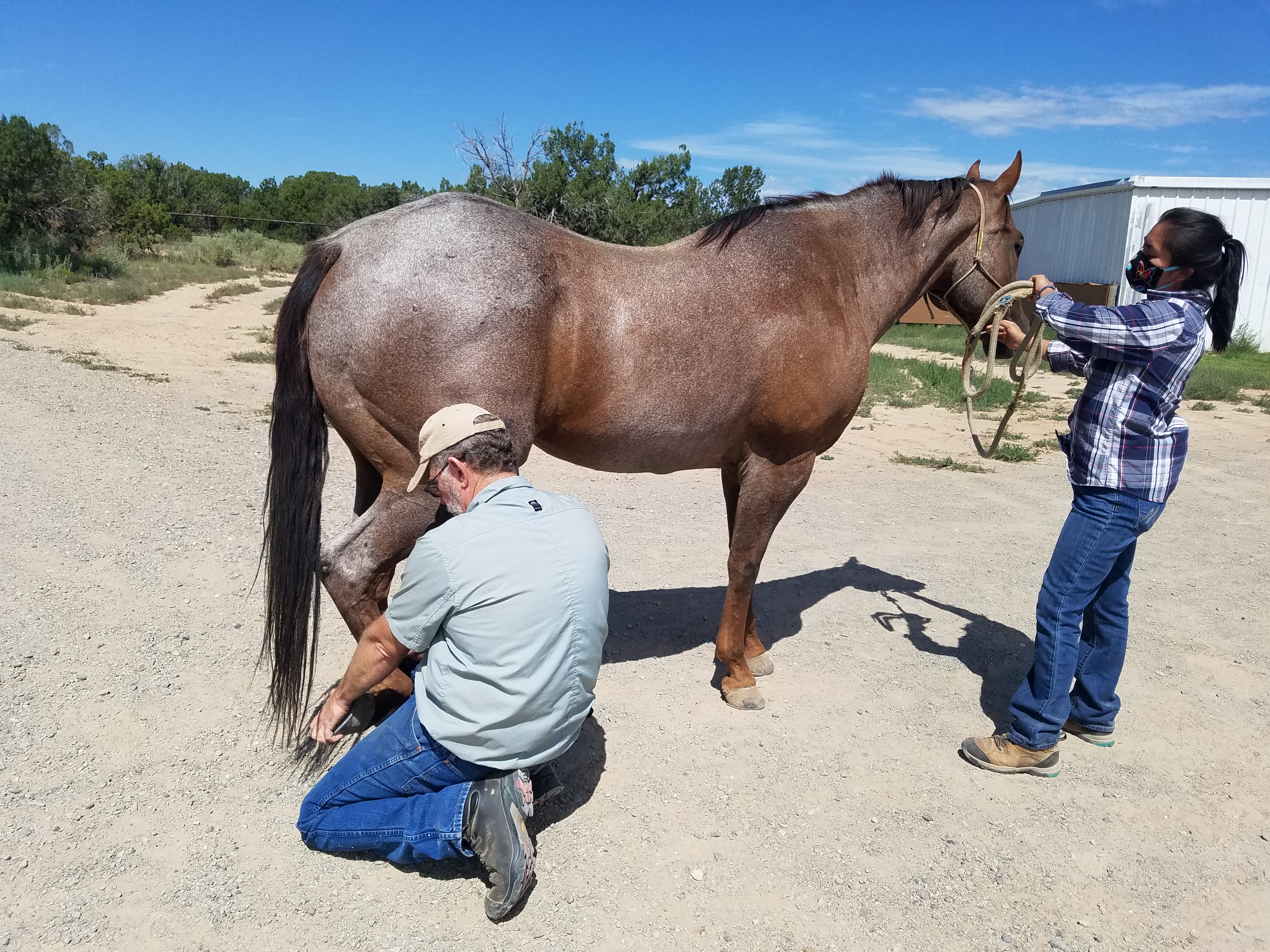
Lameness and performance horse work has been a big part of my practice since I started equine vet practice in 1993. When I started out, I was fortunate to learn from some of the best lameness vets anywhere. In Denver, Colorado at what was then the Littleton Large Animal Clinic, Marvin Beeman and Terry Swanson taught me the importance of objectivity: trying to control as many variables as possible in order to more reliably diagnose gait changes indicating lameness. Typical lameness diagnosis primarily involves observation of head movement, limb movement and movement of the pelvis as the horse trots in different patterns. Over time, this routine becomes an art—observation of a complex mixture of gait features that leads equine vets to know a horse is lame in a particular limb.
I learned to interpret a horse’s conformation a certain way in light of its job, knowing that this might provide clues as to what might be wrong with it. I was taught to palpate a horse’s body and limbs in a particular way, to do flexion exams in a particular way, to apply a hoof tester in a particular way. When watching a horse in motion, I learned that consistency and objectivity was key. It was critical to have the same good handler trot horses each time, and to see horses trot on the same hard, smooth surfaces- ideally asphalt- each time I examined them.It was drilled into me that I needed to be as consistent in the application of the diagnostic tests as I could possibly be, or I would come to the wrong conclusions. Even being that methodical and objective, I would still make mistakes and I would miss subtle conditions. Over (currently 33 years as of 2026) of doing these exams frequently and regularly, I have experienced a thousand pitfalls that can happen when objectivity meet subjectivity.

It wasn’t unusual in my early days to embark on full-day lameness exams in which we blocked (numbed nerves and joints) from the foot to the hip. I learned so much from those cases, but they were extremely challenging. I also learned the limitations of our examination techniques, both in our ability to observe objectively, and also in the reliability of many of our diagnostic tests, including blocking and imaging.
The most challenging lameness (and poor performance) cases are usually horses with very subtle hind-limb lameness, subtle gait deficits referable to the neck or spine, or gait deficits caused by a neurologic or muscle factor, and especially multi-limb lameness. Some degree of lameness in multiple limbs is a lot more common than we tend to think, and those cases are often really challenging to sort out. If it is SO hard to see and reproduce a subtle, complicated lameness consistently, then how are we to localize and diagnose it definitively? How are we going to know whether our treatments have helped?

As of 2016 or so, I had been in practice 23 years and I still felt limited in my ability to consistently and objectively evaluate subtle lameness. I had even then felt for years like our 0-5 AAEP lameness grading system was far too subjective and imprecise. I had a hunger for more precise gait and lameness analysis.
A NEW APPROACH
In the early 2000s, Kevin Keegan, a professor of surgery and lameness at the University of Missouri vet school, began work on a system of inertial sensors to track movement of different parts of the horse as it trots. The system was named the “Lameness Locator”. The company became Equinosis, and their only goal and product since has been OBJECTIVE lameness evaluation. Dr Keegan started by scientifically nailing down the movement variables that were most reliable in determining lameness. He proved that some of the methods we were using were really not that reliable after all, and he proved that the human eye was just not that reliable either. He then figured out a system that would reliably measure the important variables.
HOW DOES IT WORK?
“Lameness Locator” (lets call it the EQUINOSIS-Q instead) is an inertial sensor-based motion analysis system. It detects and quantifies movement asymmetry using 3 small wireless inertial sensors mounted on the horse, joined via long-range wireless connection to a hand-held tablet computer. The system samples motion about 10 times faster and more sensitively than the human eye can. The software utilizes special algorithms developed over years to measure and analyze lameness and filter insignificant movement.
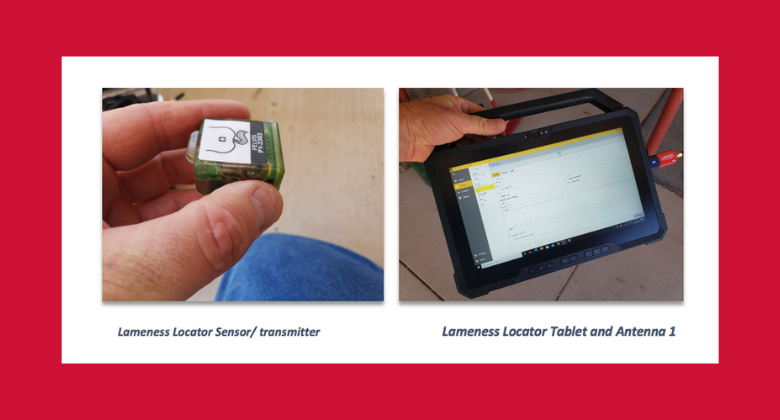
The system is quick and easy to set up and use and doesn’t hurt the horse a bit. There is a sensor for the head at the poll, one for the right pastern and one that sticks via adhesive to the top of the hip.
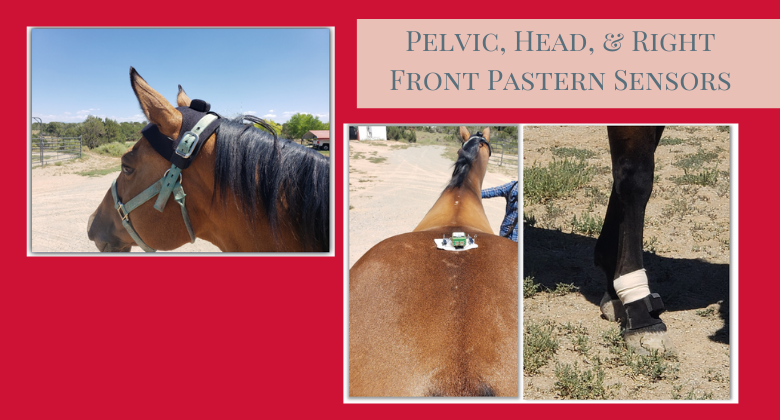
When we are ready to trot the horse, we hit the start button, the system starts recording and the horse trots enough strides to gather the needed data – 25 strides for the straight line for instance. Multiple trials are run- often starting with the straight line, then lunged circles, pre and post flexion, pre and post-blocks or pre and post-treatment. Whatever we choose to do. The trials are analyzed and a whole variety of individual and comparison reports can be generated in seconds, so we can make decisions in real-time. I can show a rider, trainer or owner the obvious differences.
For each of these trials, the system indicates whether there is lameness (indicated by a subtle difference in the movement of left forelimb vs right forelimb, and left hindlimb vs right hindlimb. It measures the timing of any lameness within the stride for each limb, (push-off vs impact)- and the amplitude (severity) of the lameness. It puts a specific precise amplitude of the lameness- an objective measure much more accurate and reproducible than our AAEP lameness scale or our eye. Rather than relying on our eyes and our opinion in that moment, it puts this precise numeric value to the deficit and it represents it visually. That turns out to be a very big deal! That objective information provided is incredibly helpful. It saves time and adds confidence to both the initial evaluation and any follow-up.
Lameness Locator doesn’t tell us anything more than this. It is still up to us as lameness clinicians to determine what structures of the limb are involved and the nature of the injury to those structures. To do this we still need an excellent clinical exam, blocking and imaging. We then need to determine the best treatment and provide a management plan and a prognosis.
Here is an example of a Lameness Locator report.
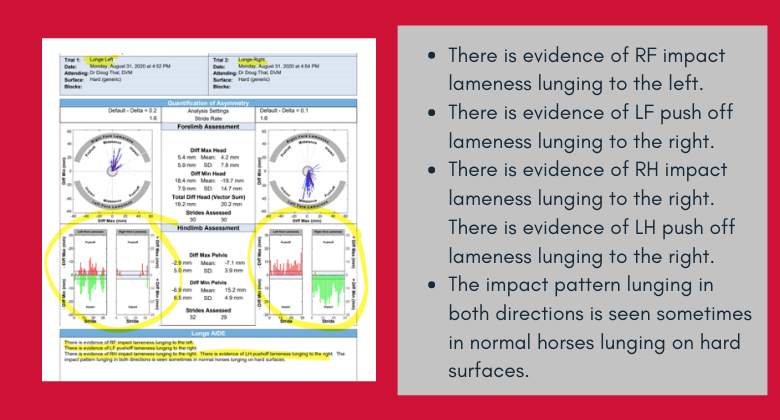
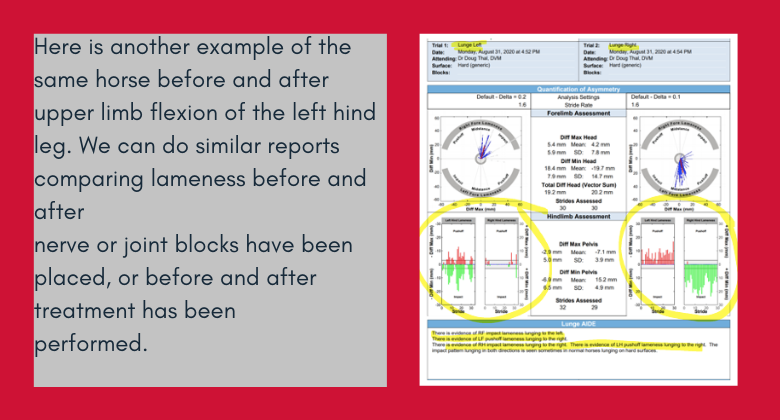
The circles at the top represent the left and right forelimbs. The rectangles below represent the hind limbs. This is a lunging comparison of left and right hind limbs. This turned out to be a horse with lameness in both hind legs. It shows that the lame leg shifts when the direction of trotting changes. I highlighted the comments made by the program. It provides nice summaries like this, but there is far more to the report in the details and numbers. In this case, the mild lameness in front is probably not significant. For any report, the vet MUST interpret the report in light of the clinical situation and makes a decision about how significant the findings are.
HMM.. I DON’T KNOW ABOUT THIS THING..
I was skeptical when I first saw the lameness locator advertised several decades ago. Having seen and treated many hundreds of lame horses by that point in my career, I sure didn’t feel I needed this little device to tell me what leg a horse was lame on. No, the problem wasn’t that after all, I thought. The problem was determining the particular structure of that limb that was injured, the nature of the injury, and how to treat it.
Yes, it was no “LAMENESS LOCATOR” but it sure was a valuable tool! The more I studied the company and what the device was actually doing, the more interested I became. If I could be really precise in determining whether there was a subtle difference before and after something I did- more subtle than I could see with my eyes- then that would be valuable. After considering it for years, I finally bought the system about 10 years ago. Now, having used it hundreds of times on all kinds of horses, I can say that it has been a game changer for me.
No, it doesn’t make lameness diagnosis easy. No, it doesn’t tell you miraculously where exactly the horse hurts. In fact, when you have this all this data, you realize just how unbelievably complex lameness is. You still have to be an expert lameness clinician and you still have to do the hard work (excellent clinical exam, blocking, imaging) like we did before. You still need to know anatomy, and how to block and image, and all the other things a lameness clinician knows. But…. OBJECTIVE lameness diagnosis DOES make all that work more meaningful and reliable and it documents the whole exam in perfect detail. It make the work more precise and more valuable. It allows me to very specifically visualize the difference in a horse’s movement before and after flexion, blocking or treatment.
HOW IT IS USED IN OUR PRACTICE
- *Referral lameness cases. I see quite a few horses as a second opinion, for diagnosis and treatment. The Q has been especially useful for complex and subtle lameness cases- evaluating horses pre and post flexion, pre and post block. It has allowed me to provide a professional, precise report showing that horse in that moment.
- *It is excellent for monitoring the progress of treatment, and management of subtle lameness conditions. Is the management/ treatment approach working or not?
- *Purchase exams! Is a horse subtly lame at purchase exam or not? Significant lameness is easy, but subtle, especially hind limb lameness or multi-limb lameness is challenging. It’s nice to have a visual report to back up the clinical exam, to double check our eyes, put a number on the lameness and represent it graphically. Doesn’t that add another layer of confidence; to hold a report that says that on the day you purchased the horse there was no lameness?
- *For some performance horses, I do quarterly exams to be sure we are on track. The rider may think he is ok, but this confirms that yes, he is in fact as good or better than last time.
- *In a perfect world, I do think every ridden horse should have a baseline lameness exam. Not to be sure he is perfect, (cause that doesn’t exist) but to see where he is, and record it, and be sure he isn’t becoming more lame.
- *At this point, I think it makes sense to incorporate a brief lameness exam into our annual and semi-annual exams health exams, at least for ridden horses. It really should just be like checking teeth and general health.
SOME FINAL WORDS
In the near decade since I brought this technology to our practice, OBJECTIVE lameness work has become more and more mainstream in the industry. There are more and more systems and devices out available, measuring gait information. The EQUINOSIS aka the LAMENESS LOCATOR was the first one of these and it is grounded in hard science. It has had far more objective data and research supporting its use than the other systems I am familiar with. Using this system has allowed me to up my game with respect to lameness and poor performance exams.
Objective lameness measurement represents the future of lameness assessment. These days, veterinary schools worldwide are training new veterinarians in the use of this and similar technology. To learn more about the lameness locator, visit www.equinosis.com





 .
.