For Veterinarians | Horse Side Vet Guide

For Veterinarians

Dear Fellow Veterinarian,
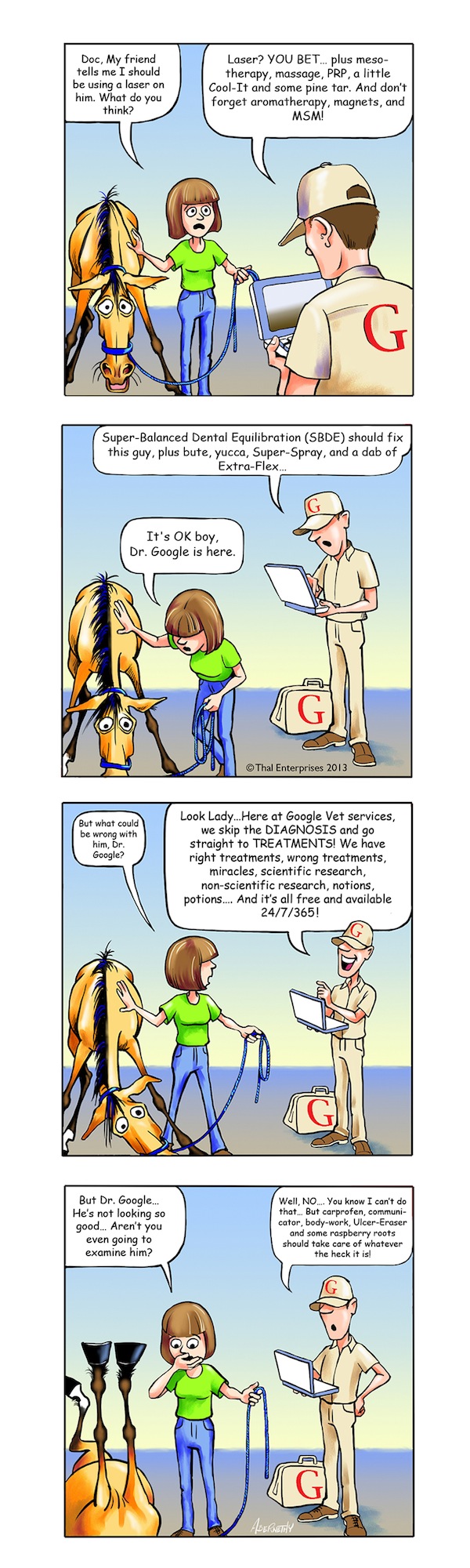
I have been in equine veterinary practice for 33 years. When I wrote the original version of this letter over a decade ago, my concern was that horse owners were increasingly turning to Dr Google instead of calling their veterinarian. That the Internet was eroding the Veterinary-Client Patient Relationship, and that horses were being harmed by self-help that bypassed the procurement of a diagnosis by their vet. I created this comic to illustrate the problem.
That problem has gotten dramatically worse. Today, horse owners don’t just Google their horse’s symptoms — they ask ChatGPT, Gemini, or whatever AI is on their phone. They get confident-sounding answers that have no clinical grading, no REAL understanding of urgency, and no awareness that what they really need is a veterinarian. The AI doesn’t know the difference between a horse that can wait until morning and one that needs a vet now. And while it may say “Call your vet”, it certainly doesn’t reinforce the critical role you play.
So what do we do about it?
fin3_verticalb copy 2What HSVG Was Built to Do
In 2011, long before anyone was talking about AI, I started building something I couldn’t find anywhere else: a database that connects the observations horse people make — the things they actually see and describe — to their possible causes, graded by likelihood based on my clinical experience. The idea was simple: if a horse owner could make an observation and immediately access credible, structured information about it, literally “horse side,” they’d be better prepared to communicate with their vet. And they’d understand why they need one.
That became Horse Side Vet Guide. Over 8,000 records organized into inter-related categories — Observations, Diagnostics, Diagnoses, Treatments, Skills, Supplies — intentionally structured to distinguish between what the horse owner can do and what requires a veterinarian. Over 52,000 graded relationships connecting observations to diagnoses, each weighted by clinical likelihood. Not generated by software. Built by hand, one relationship at a time, and based on decades of practice experience.
The core principle has never changed: HSVG exists to strengthen the Veterinary-Client Patient Relationship, not to bypass it.
We recently added an AI assistant to HSVG. But this is not a generic chatbot. It is an AI that navigates the clinical knowledge graph I built — those 52,000+ graded relationships — and uses them to guide horse owners toward the right information. It asks follow-up questions, assesses urgency, links to detailed HSVG records with photos, videos, and step-by-step skills, and tells the user when they need to call their veterinarian.
The difference between this and what your client gets from ChatGPT is fundamental. Generic AI gives a confident summary cobbled together from a million sources around the internet. The HSVG assistant navigates a curated clinical map — built by an equine veterinarian, for the purpose of supporting veterinary practice. It doesn’t guess. It doesn’t make up answers. It guides users to the right content, teaches them to make useful observations, and drives them toward you when it matters.
Why This Matters to Your Practice
Your clients are going to use AI for health questions about their horses. That ship has sailed. The question is whether they use a tool that undermines your role or one that reinforces it. Here is what the HSVG assistant does differently:
It triages urgency. When a horse owner describes signs consistent with an emergency, the assistant says so clearly and tells them when to call their vet immediately. It doesn’t bury that in a paragraph of caveats.
It teaches observation skills. When the assistant recommends checking a heart rate or assessing digital pulse, it links to step-by-step HSVG Skills with video instruction. Your client shows up having actually gathered useful clinical information, instead of reading you a paragraph they got from the internet.
It respects the line between observation and diagnosis. This is baked into the architecture. HSVG was built around the distinction between what a horse owner sees and what a veterinarian determines. The AI maintains that distinction. It helps the owner understand what might be going on, but it does not diagnose.
It makes your phone calls more productive.When a client calls you after using HSVG, they come with observations, vitals, and context. They can describe what they’re seeing in terms that are useful to you. That’s a different conversation than “I think my horse has [something they read online].”
A Request
I am asking you to take a look at HSVG and try the AI assistant yourself. Ask it the kinds of questions your clients ask you at 10pm. See how it responds. See whether it reinforces your value or undermines it. I believe you’ll find that it does what I intended from the beginning — it supports the relationship between horse owner and veterinarian.
If you agree, I’d ask you to recommend HSVG to your clients. Not as a replacement for your guidance, but as a resource that makes your clients better partners in their horse’s health care. A tool that prepares them to work with you more effectively.
Your clients are going to use AI. I’d rather they use HSVG.
Sincerely,
Doug Thal DVM DABVP Equine Practice
horsesidevetguide.com
“Invention, my dear friends, is 93% perspiration, 6% electricity, 4% evaporation, and 2% butterscotch ripple.” – WW

CONTACT US

We're not around right now. But you can send us an email and we'll get back to you, asap.

Sending